AI Workflow Automations
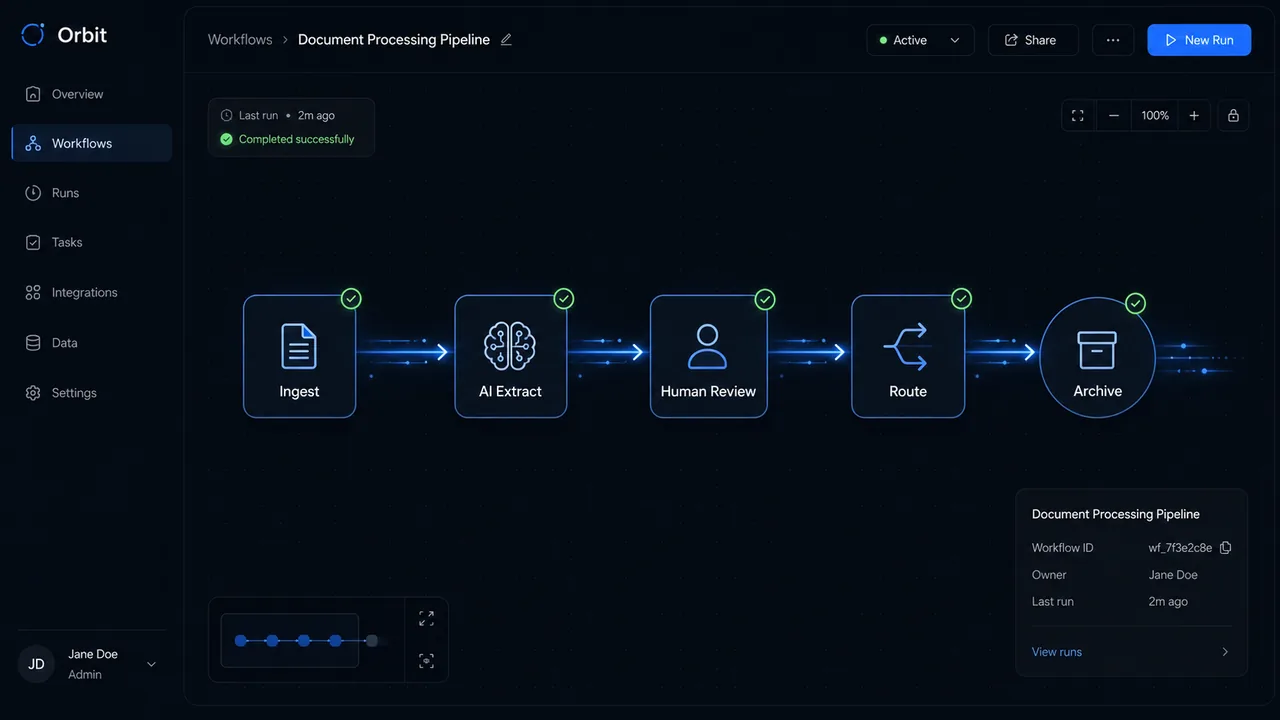
Agents and pipelines that retire the busywork, document processing, routing, enrichment and more, built event-driven, observable, and with a human in the loop wherever it matters.
AI workflow automation uses agents and pipelines to handle multi-step work that used to need a person, reading a document, extracting fields, deciding where it goes, and acting. Done responsibly, it pairs autonomy with guardrails and human checkpoints, so you get speed and accuracy without losing control.
What's included
- Multi-step AI agents, Agents that plan, call tools and complete real tasks end to end.
- Event-driven triggers, Pipelines that fire on a webhook, an upload, a schedule or a queue message.
- Human-in-the-loop, Checkpoints where a person reviews or approves before anything irreversible happens.
- Observability built in, Logs, traces and metrics so you can see exactly what every run did and why.
Our approach
We map the workflow, find the steps that are safe to automate, and design clear handoffs for the steps that aren't. Autonomy is a dial, not a switch, we add guardrails, evaluations and human checkpoints that hold up at scale.
Every automation ships with observability, so you can trust it, debug it, and expand it confidently.
From idea to shipped in four phases.
Map
Document the workflow and its decision points.
Design
Decide what to automate and where humans gate.
Build
Ship agents and pipelines with full logging.
Scale
Expand coverage as confidence grows.
Frequently asked questions
What can AI workflow automation actually do?
It can read and classify documents, extract and enrich data, route items to the right place, draft responses and trigger downstream actions, chaining these steps together with AI agents. Document-heavy back offices are a particularly strong fit.
Is it safe to let agents run autonomously?
We treat autonomy as a dial. Low-risk steps run unattended; anything irreversible passes through a human checkpoint. Combined with guardrails, evaluations and full observability, this gives you speed without losing control.
How do you measure whether an automation is working?
Every automation ships with logs, traces and metrics. We track accuracy against a labeled set and monitor throughput and exceptions, so you can see the time saved and catch drift early.